
The Second Indian War
 The Second Indian War (also known as King William’s War) lasted from 1688 to 1697, a struggle between the settlers, and an ally-relation between the French and the native Wabanaki in New England. This conflict ensued just over 10 years following the previous uprisings of conflicts between these groups. While the First Indian War had been over the fur trade, this war was primarily about land grant issues; the colonists came along and claimed land that the Indians had always claimed.
“... in August 1688 set off a panic in Massachusetts, and on the Maine frontier. Wild
rumors about 200- or 700, or 2,000- local Indians gathering at Pennacook with French officers and French Indians to ‘consult about a war with the English’” (Norton 94).
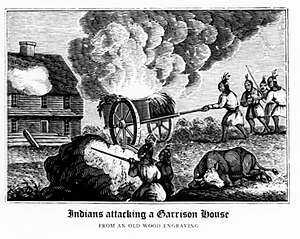
 The Indians began this war by massacring in New England (they had started both of the wars). William Stoughton was sent from Boston in response to the capture of 16 English settlers by the Wabanakis in an attempt to work out an exchange. For some reason, he was unable to contact the Indians, so he sailed back to Boston on September 19 without the captives. The first bloodshed was a result of the Wabanakis becoming spooked by a small group of colonists that they encountered, and therefore killing some of the prisoners. The battles between the Indians and New Englanders were a sort of Guerilla Warfare. They used surprise attacks, killing, injuring, and affecting many people. There was much discussion and planning between tribes and groups for how to approach an attack on the English settlers. On the other side, in the New Englanders’ eyes, Indians were “Satan’s Minions,” (JSTOR). During the war (specifically 1689), Governor Andros was overthrown and Simon Bradstreet takes his place. Shortly after, a surprise attack was initiated by the Wabanaki. The “Treaty of Ryswick” on September 20, 1697 was a truce to end the violence and battles, though the conflict strongly continued.
 The Second Indian War took place on the frontier, arguably a main contributor to the Salem Witch Hysteria that ensued. The horror and bloodshed contributed mentally and physically to the crisis in Salem. While the French and Wabanaki were Catholic, the New Englanders did not have a strong faith or connection with a god, thus some believe that they were being punished by God for not being “good” Christians. Not only did the people of Salem have to cope with constant attacks by Indians and the French, but they were also living life on the frontier, which was a serious detractor to the well-being of the people. Also, many injuries and cuts from the War left settlers with Devil’s mark-like scars.

LINKS/SOURCES FOR FACTS AND IMAGES:
In the Devil’s Snare by Mary Beth Norton

http://upload.wikimedia.org/wikipedia/commons/thumb/1/1a/King_williams_war.svg/638px-King_williams_war.svg.png
http://griffithparkwardgenealogy.blogspot.com/2012/12/looking-for-patriot-colonial-wars.html
What was the massacre in New England, or was it just the killings that occurred regularly. Also, why do you think the Indian warfare caused the people of Salem to turn to witches specifically. Was it a direct effect or more of a subconscious thing.
ReplyDeleteDo any of you know how many colonists/native americans were killed? I'm just trying to figure out how detrimental this war was to Salem and the surrounding native tribes.
ReplyDeleteDo you believe as an individual the colonists had it coming? Though the natives started the conflict, do you believe that they had the right to start the Second Indian War, or are they just instigators?
ReplyDeleteHow did the Wabanaki attack turn into Guerilla warfare? Were they just between the Indians and New Englanders, or were there other factors involved in this ? How did this effect the English settlers in the long run? Did it have a great impact for the second Indian war? What came after this for the settlers?
ReplyDeleteWhy do you think the French attempted to weaken their English rivals be siding with the Indians in the second Indian War? It seems contradictory that two nations increasing moving towards the democratic government would interact on such noncommunicatory terms. Does this indicate that the wars were mostly civilian driven?
ReplyDelete